Lifetime deal👉 DON’T MISS OUT. Limited time launch deal ends in

Alternatives · invideo

An invideo alternative for videos of a real product

invideo generates footage that was never filmed, and charges in credits to do it. CoAnimator builds the video around the product you actually have, renders it on your machine, and leaves you the project files.

macOS · Windows · Linux · no credits, no render limits

the split

What each one is

invideo generates shots that were never filmed, from a prompt, using whichever model fits. CoAnimator animates the product you already have, on your own machine.

The generator

invideo

A browser platform whose agents pick a model, write the prompt and produce each shot, drawing on Veo 3.1, Sora 2, Kling 3, Seedance and more than two hundred others, with avatars, voice clones, iStock and a timeline to assemble it all.

What it needs
A description of the film. Your own clips can be uploaded and cut alongside.
What you get
Generated footage, exported without a watermark, and a project in their app.
What you pay
$17/mo billed $200 yearly on Plus, rising to $900/mo billed $10,800 on Elite. The bill buys credits: 75 a month on Plus, spent at each model’s API price, and they do not roll over.

The studio

CoAnimator

The agentic animation studio. Your own agent builds narrated product videos out of your screens, your assets and your script. Demos, launches and tutorials, on a timeline you can open and change.

What it needs
A paragraph describing the video. Screen recordings if you have them.
What you get
A project of editable files on your disk, and an MP4 rendered on your machine.
What you pay
Free forever at 720p with a watermark. $99 once for 4K and clean exports. No credits, and nothing expires.

what you are buying

Credits that expire, or an app that doesn’t

invideo

prices subject to change

Their words: “All models available at their original API pricing”, and “We reserve the right to update credit costs at any time, without prior notice”.

CoAnimator

paid once

Rendering runs on your own machine, so the second version of a video costs what the first one did, which is nothing.

agents you already pay for

Describe it in a paragraph.
The crew does the rest.

The studio ships the crew: script, voice, scenes, timing, thumbnail, render. They run under the coding agent you already subscribe to, against your own files, so there is no second bill and no balance going down while you decide what the video should say.

Download free

feature comparison

CoAnimator vs invideo, feature by feature

invideoCoAnimator
What each one makes
Footage that never existedYes.Shots from a prompt, across 200+ models including Veo 3.1, Sora 2, Kling 3 and SeedanceYes.Generated shots from a prompt, dropped onto the timeline beside your own material and rendered locally. Not a marketplace of 200 models to choose between
Your actual product on screenPartial.Upload the recording and cut it on their timeline. The models make new footage, not a copy of your interfaceYes.The whole point. Scenes are built around your screens, your UI and your assets
Avatars and voice clonesYes.4 on Plus, 16 on Max, 40 on Generative, 200 on ElitePartial.Talking-head avatars with lip sync, rendered locally and never capped by tier. Voice runs through the TTS plugin on your own keys, so cloning is whatever your account allows rather than something we count
What runs out
CreditsNo.75 a month on Plus, 390 on Max, 800 on Generative, 4250 on EliteYes.None. You bring the agent you already pay for
Unused creditsNo.Their FAQ says unused credits do not roll over to the next monthYes.Nothing to carry over, so nothing to lose
What one generation costsNo.Models bill at their original API pricing, and the page says credit costs can be updated at any time without prior noticeYes.A render costs electricity. Trying it again costs the same
What it costs, and where it runs
Free tierNo.No free tier on their pricing page. Paid plans start at $17/moYes.The whole studio, unlimited 720p renders, forever
What it costsNo.$17/mo billed $200 yearly on Plus, up to $900/mo billed $10,800 on Elite. Annual is discounted 15% on most tiers and 10% on Elite, so month to month is higherYes.$0, or $99 once for 4K and clean exports
Where it rendersNo.Their cloud, on the model providers’ hardwareYes.Your own machine. Your footage never uploads
What you own afterwardsPartial.The exported video, and a project inside their appYes.Scenes, media and a timeline as ordinary files on your disk

the workflow

What making a video looks like in CoAnimator

  1. 01

    Brief it

    A paragraph in plain language: what the video shows, who it’s for, the tone. No prompt engineering, and no model to choose.

  2. 02

    The agent writes the scenes

    Your agent (Claude Code, Codex, Gemini, OpenClaw, or ours) writes scenes onto the templates, pulling in your screens and assets where they belong.

  3. 03

    Narration lands timed

    The TTS plugin reads the script and places every line on the timeline where it belongs, so animation beats and voice move together.

  4. 04

    Review on the stage

    Timeline, media panel, live stage. Steer with feedback like “slow the intro” or “swap that screenshot”, and watch it hot-reload.

  5. 05

    Render locally

    In-app or headless through the coa CLI. Your machine, your disk, and no balance going down while you try things.

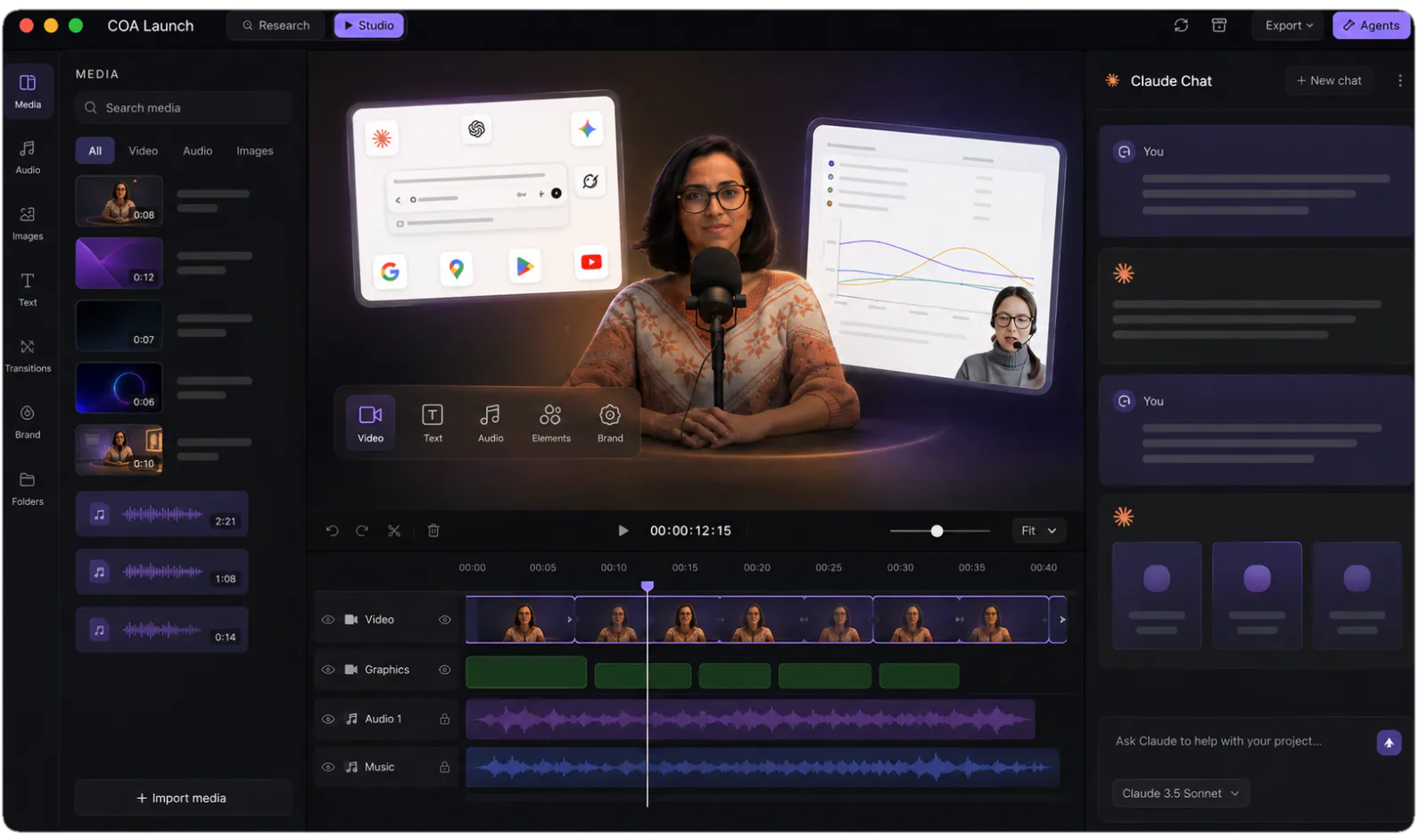
The CoAnimator studio: media library, stage and timeline with an agent chat alongside
The studio you are steering: stage, timeline and your agent, side by side.

pricing comparison

What year one looks like on each route

The invideo route, subscribed

The platformPlus, billed $200 yearly. 75 credits a month$17 / mo
Daily useGenerative, billed $2,000 yearly. 800 credits$170 / mo
What a shot costsEach model at its original API pricingcredits
When prices moveTheir FAQ: updated at any time, without prior noticeno notice
Credits you did not spendThey do not roll over to the next monthexpired
Jobs at onceConcurrency is limited on Plus, 2x to 20x aboveby tier
Storage20 GB on Plus, up to 10 TB on Eliteby tier
Trying it firstNo free tier on their pricing pagefrom $17
Year one, at the annual rate$200 Plus, $2,000 Generative, and the credits expire monthly

The CoAnimator route, installed

The studioStage, timeline, media panel, agent chat, free at 720pâś“ free
Two devices and 4KOne licence, extra device slots $29 once$99 once
What a render costsElectricity. It runs on your own hardwareno credits
When prices moveThe licence you bought is the licence you havepaid once
Anything you did not useThere is no balance to expirenothing
Jobs at onceWhatever your machine will do, not what the plan allowsno tier
StorageYour own disk. The project is ordinary filesyours
Trying it firstFree forever, and it is the whole studioâś“ free
Year one$0, or $99 once

everything included · one licence later unlocks 4K · no credits, no meters

made with coanimator

Videos shipped from the studio

Both show real products doing real things, and both were built end to end in CoAnimator: script, scenes, voiceover and render.

MCP360: full product demo
MCP360: full product demoWatch on YouTube ↗Ten scenes, a ten-part voiceover, sound effects and a music bed. The whole 81-second demo, rendered locally.
Copilot SDK v2.5: feature demoView on X ↗
the showcaseEvery finished video, start to renderEach one with what it took to make →

FAQ

Is CoAnimator a good invideo alternative?

It depends on what the shot has to be. Both generate footage from a prompt, so that is not the split. What invideo has is the marketplace behind it: Veo 3.1, Sora 2, Kling 3, Seedance and more than two hundred other models to pick between, with an iStock library alongside them. For an ad or a short film, where the look of the shot is the product, that choice is worth paying for. CoAnimator is a desktop studio where your own coding agent builds a video around your real product: your screens, your UI, your assets, on a timeline you can open, rendered on your machine. A generative model can invent a beautiful dashboard. It cannot show yours.

What does invideo cost, and what runs out?

Read off their pricing page in August 2026: Plus is $17 a month billed $200 yearly, Max $85 billed $1,000, Generative $170 billed $2,000 and Elite $900 billed $10,800. The toggle beside the prices advertises annual at 15% off on the first three tiers and 10% on Elite, so month to month costs more than the figures shown. What the money buys is credits: 75 a month on Plus, 390, 800 and 4,250 on the tiers above. Their FAQ says models are billed at their original API pricing, that credit costs can be updated at any time without prior notice, and that unused credits do not roll over. CoAnimator has no credits at all: the free tier renders 720p forever, and $99 once unlocks 4K.

Does invideo have a free plan?

Not on their pricing page, which starts at $17 a month billed $200 yearly, and the word free appears nowhere on it or on their homepage. Review sites do describe a $0 plan with watermarked exports and a weekly quota, but they disagree with each other and quote prices invideo no longer charges, so this page will not tell you what it includes. CoAnimator’s free tier is the whole studio, with unlimited 720p renders and a watermark, for as long as you want it.

Can invideo make a demo of my product?

You can upload your screen recording and cut it on their timeline, so a demo is possible. What the generative half cannot do is produce your interface, because it makes footage that never existed rather than a copy of something real. On invideo your product footage is an upload the platform edits around. In CoAnimator it is the subject the whole project is built on, with titles, spotlights and motion placed against it by your agent.

What does CoAnimator not have that invideo does?

Generative video from a prompt, access to two hundred and more models, AI avatars, voice cloning, an iStock and Storyblocks library, storyboarding, multiplayer editing, and nothing to install. If those are the features you are shopping for, buy invideo. CoAnimator does one job: it builds and renders product videos on your own machine.

Where does the rendering happen?

On invideo it happens in their cloud, on the model providers’ hardware, which is what the credits are paying for. CoAnimator renders on your own machine, so your footage never uploads and a second version of a video costs exactly what the first one did. For a screen that shows an unreleased feature or a customer’s account, that is often what decides it.

What happens to the video after it is made?

In CoAnimator the video stays a project of ordinary files: scenes, media and a timeline. When the product changes you swap the clip that went stale and re-render, and the rest comes through untouched. Rendering is one command through the coa CLI, so a release script can re-render every video you own, and the whole project lives in git alongside the code it documents.

Make the whole video before you pay anything

Every template, every look and unlimited local renders at 720p. Nothing is metered, no balance goes down while you work, and your footage never uploads.