The short answer: most SaaS product demo videos cost $1,500 to $15,000 if you hire a professional. A 60-90 second homepage explainer lands around $800 to $8,000. A simple screen recording with voiceover starts near $100. A fully animated launch film can exceed $25,000.
Those numbers are only the beginning. The real budgeting question is what a steady stream of demo content costs, because one video is rarely enough. Product demos go stale the moment your UI changes. Landing pages with video convert higher, but only if the video stays current.
This guide breaks down every production method, shows where the money goes, compares traditional and AI-assisted workflows, and gives you a decision framework for the next budget conversation.
What this guide means by “product demo video”
A product demo video shows your software in action. It walks a viewer through a real workflow, highlights the payoff, and ends with a clear next step. Formats include:
- Homepage hero demo: a 60-90 second overview that lives above the fold.
- Feature explainer: a focused 30-60 second clip for a single capability.
- Onboarding/tutorial: a 2-3 minute walkthrough that reduces support tickets.
- Sales enablement demo: a reusable asset the sales team sends before calls.
- Social/ads cut: a 15-30 second variant optimized for a platform.
This guide focuses on SaaS and B2B software demos, where the product lives on a screen. The numbers differ for physical products, live-action shoots, and 3D animation, and we note those where relevant.
The six ways to produce a product demo video in 2026
Most teams choose one of six production routes. Each has a different price, timeline, and set of trade-offs.
1. DIY with screen recording and basic editing
You record your screen with a screen recorder, write your own script, and edit in something free or low-cost. A polished Mac screen recorder can give platform recordings a clean look. Hard costs can be near zero if you already own the software.
The hidden cost is time and quality. A polished two-minute demo can eat a full day or more once you factor in scripting, multiple takes, voiceover, and editing. The output often looks like an internal recording rather than a marketing asset. DIY works for quick internal walkthroughs or scrappy early tests. It rarely holds up as a homepage or paid-ad asset.
Typical cost: $0-$100 in hard costs, plus 8-20 hours of your time.
2. AI-assisted creator tools
AI video tools can generate voiceover, music, captions, B-roll, and even full scenes from a description. Entry-level subscriptions run from about $8 to $35 per month based on 2026 tool pricing pages, and raw model costs can be under $0.40 per second of generated footage.
The catch is that these tools usually output clips, not finished videos. You still need to assemble, edit, color-match, caption, and review. 2026 operator analyses of AI video production found that the real per-video cost is typically 3-4x the advertised compute cost once prep, revisions, captions, and review are counted. AI tools are fastest when the format is simple, such as slideshows with narration, faceless explainers, or avatar-led training clips.
Typical cost: $20-$200 per month in subscriptions, $5-$50 per finished short at low volume, higher for complex edits.
3. Freelancers and small studios
A freelance video editor or animator is the most common next step. Rates vary widely. Screen recording edits may run $75 to $250 per video based on 2026 freelance platform data, while a full 60-90 second explainer with custom animation ranges from $800 to $5,000. Specialized SaaS studios quote $2,500 to $7,000 for a professional product demo.
Freelancers give you flexibility and a direct relationship with the person doing the work. The downsides are availability, inconsistent quality, and management overhead. Your favorite editor may be booked when you need a fast turnaround.
Typical cost: $500-$7,000 per finished video depending on complexity and region.
4. Mid-market agencies and production subscriptions
A mid-market agency handles concept, script, animation, voiceover, and revisions under one project fee. SaaS product demos from agencies typically run $3,000 to $15,000 per video, and 60-90 second explainers average $4,000 to $10,000. Retainer or subscription models charge a flat monthly fee for a dedicated team and predictable output.
Agencies are the right call for flagship videos where production value matters. For ongoing demo content, the per-project model gets expensive because every new video means a new quote, new scope, and new timeline.
Typical cost: $3,000-$15,000 per project, or $2,500-$16,500 per month on subscription/retainer.
5. Premium production and brand films
Premium agencies and brand studios produce cinematic launch films with custom illustration, 3D animation, live-action talent, and original music. A 60-90 second 2D motion-graphics demo from a top studio can run $8,000 to $25,000. A 3D product visualization or premium brand film can climb past $50,000.
This tier makes sense when the stakes are high, such as a major launch, a fundraising video, or a homepage hero for a high-ACV product. It is overkill for a feature update clip or a tutorial series.
Typical cost: $8,000-$50,000+ per finished video.
6. Agentic animation studios
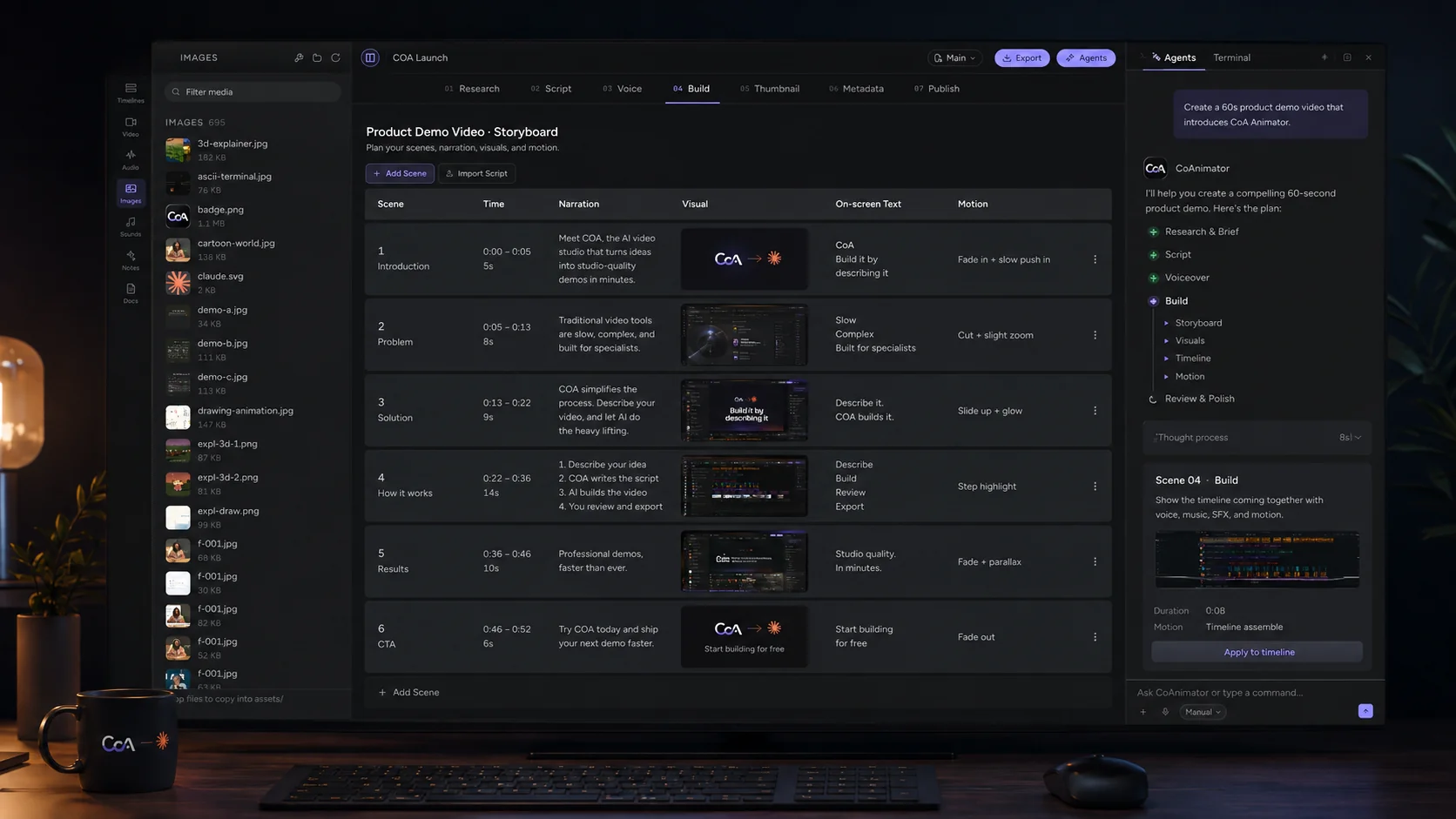
Agentic tools represent the newest production path. You describe the demo you want, and an AI agent builds it scene by scene. The agent drafts the script, places screen recordings, adds motion, timing, voiceover, and effects, and updates a live stage as it works. You review, adjust, and render locally.
CoAnimator fits here. It is a desktop studio that works with Claude Code, Codex, Gemini CLI, or its own agent. Projects are stored as plain editable files, so you can update a scene and re-render when your product changes without rebuilding the whole video. Everything renders locally, which means unlimited exports and no watermark on paid licences. During its private preview, CoAnimator is offered as a $99 lifetime subscription for early adopters who want an editable, agentic alternative to metered cloud tools.
Typical cost: $99-$490 one-time or per year for a licence, depending on tier and timing.
Product demo video cost by production method
| Method | Typical per-video cost | Timeline | Best for |
|---|---|---|---|
| DIY screen recording | $0-$100 plus your time | 1-3 days | Internal clips, early tests |
| AI-assisted creator tools | $20-$200/mo subscriptions; $5-$50 per short at low volume | Hours to days | High-volume short-form, avatars, faceless explainers |
| Freelancer / small studio | $500-$7,000 | 1-4 weeks | One-off demos, moderate polish |
| Mid-market agency / subscription | $3,000-$15,000 per project, or $2,500-$16,500/mo | 2-6 weeks per project | Flagship demos, ongoing content programs |
| Premium production | $8,000-$50,000+ | 4-12 weeks | High-stakes launches, brand films |
| Agentic animation studio | $99-$490 one-time or yearly licence | Hours to days | Teams that update demos frequently and want editable files |
Figures are 2026 market ranges drawn from published agency rate cards, tool pricing pages, and production-service quotes.
Cost by demo type and quality tier
The same production method can produce very different costs depending on the format.
| Demo type | Basic | Mid-range | Premium |
|---|---|---|---|
| Homepage hero demo (60-90s) | $800-$3,000 | $3,000-$8,000 | $8,000-$25,000 |
| Feature explainer (30-60s) | $500-$1,500 | $2,000-$5,000 | $5,000-$15,000 |
| Onboarding/tutorial (2-3min) | $300-$1,500 | $1,500-$5,000 | $5,000-$12,000 |
| Sales enablement demo (1-2min) | $500-$2,000 | $2,000-$5,000 | $5,000-$15,000 |
| Social/ads cut (15-30s) | $200-$800 | $800-$2,500 | $2,500-$10,000 |
Basic tiers use screen recording, template graphics, and minimal animation. Mid-range adds custom motion, professional voiceover, and branded assets. Premium includes bespoke animation, live-action, 3D, or original music.
What product demos look like when they are built with an agent
Published agency case studies are useful, but they describe a different workflow. They show what a human studio charges. They do not show what happens when the same quality is produced by an agent that drafts, revises, and re-renders from plain files.
The clearest examples we have are the videos we shipped inside CoAnimator. They were not produced by an external studio and then imported. The agent built the scenes, placed the recordings, added the motion, timed the voiceover, and rendered the final MP4 on a local machine.
| Video | What it had to do | What the agent handled | The outcome |
|---|---|---|---|
| MCP360 product demo | Explain a new product clearly, with narration, in one polished cut. | Full scene construction, voiceover placement, motion, and local render. | A complete demo produced end to end inside CoAnimator, used as a private-preview proof point. |
| Copilot SDK v2.5 launch video | Ship a launch film that could compete with studio-produced category announcements. | Script drafting, scene building, effects, timing, and re-renders as the message evolved. | Reached 417K views and became a reference for what an agentic workflow can produce. |
| Homepage single-sentence edits | Turn raw footage into stylized clips from a one-line description, no timeline work. | Style matching, freeze frames, text effects, color treatments, and render. | Four distinct looks (action-film intros, glitch titles, sticker borders, cinematic depth) created from one sentence each. |
These are not concept reels. They are shipped work. The MCP360 demo and the Copilot SDK launch video both went through the same workflow a customer would use: describe the outcome, watch the agent build it, review the live stage, and render locally.
The budget advantage is not just the first cut. It is what happens after the product changes. A traditional demo that costs $8,000 to produce costs nearly the same to update when the UI shifts. With an editable agentic project, the same update is a scene swap and a re-render. The production value stays, but the refresh cost drops by an order of magnitude.
Source details are drawn from CoAnimator’s own showcase work and the MCP360 and Copilot SDK v2.5 demos produced in the private preview.
What actually drives the cost
Every line item on a video quote traces back to one of these drivers.
1. Length
Longer videos cost more because they require more script, more footage, more animation, and more review surface. Every additional 30 seconds typically adds 30-40% to the production cost for animated explainers. Most effective SaaS homepage demos stay between 60 and 90 seconds.
2. Animation and motion graphics
Plain screen recording with light editing sits at the low end. Animated UI callouts, kinetic type, and custom motion graphics push the price up. Fully custom 2D animation runs $5,000 to $15,000, and 3D visualization starts around $18,000.
3. Voiceover and audio
A basic freelance voiceover costs $100-$300. Broadcast-quality talent costs $300-$800 per finished minute. Premium or recognizable voices can exceed $1,000 per minute. AI voiceover from a leading AI voice tool costs far less per minute but still needs cleanup and review.
4. Live-action production
Crew, location, talent, lighting, and travel add $2,000-$10,000 per shoot day. For most SaaS products, screen recording or animation communicates the value more cleanly and cheaply than live action.
5. Revisions
Most quotes include 1-3 revision rounds. Additional rounds cost $500-$2,000 each. Disorganized feedback is the single most common cause of budget overrun. Some studios estimate that revision loops alone can inflate a budget by 20-40%.
6. Platform formats
A 16:9 hero video usually needs 9:16, 1:1, and 4:5 variants for social. Each additional format adds $200-$500 in post-production.
7. Urgency
Rush delivery typically adds 25-100% to the base price. A project compressed from four weeks to one week can double the cost.
8. Script and strategy
If you hand over a finished script, you save money. If the producer has to research your product, interview stakeholders, and write a conversion-focused script, expect to pay $500-$2,000 for that work.
Traditional production vs. AI-assisted production in 2026
The biggest shift in 2026 is not that AI has replaced human production. It is that AI has split the market into two distinct cost structures.
Traditional production is front-loaded and project-based. You pay for script, storyboard, animation, voiceover, and revisions. A single 60-90 second agency demo costs $5,000-$12,000 and takes 3-6 weeks.
AI-assisted production is subscription or usage-based. You pay for tools, compute, and some human polish. A 30-second AI-assisted short can cost $20-$50 in fully loaded cost. The challenge is consistency, brand control, and editability.
| Factor | Traditional production | AI-assisted production |
|---|---|---|
| Cost structure | Per project or retainer | Subscription, credits, or API |
| Timeline | 2-6 weeks | Hours to days |
| Editability | Source files available, but edits often billable | Varies; some tools hand back uneditable clips |
| Brand consistency | High, with human direction | Requires strict templates and review |
| Volume economics | Expensive at scale | Cheap at scale for simple formats |
| Best use case | Flagship demos, brand films, high-stakes launches | High-volume social clips, avatars, internal training |
The most effective teams in 2026 use a hybrid. They produce a polished master demo through traditional or agentic production, then use AI-assisted tools to generate platform variants, personalized cuts, and feature updates at low marginal cost.
The 2026 AI and agentic workflow shifts
Several changes are reshaping demo video budgets this year.
AI adoption is now mainstream. 2026 video marketing surveys report that 63% of video marketers have used AI tools to create or edit marketing videos, up from 51% the year before. AI is no longer a novelty; it is a standard part of the production stack.
Raw compute cost keeps falling. Per-second AI video generation cost fell roughly 60% per year from 2024 to 2026. The cheapest production-quality models now sit around $0.04 to $0.10 per second.
The real cost is now labor, not compute. As generation becomes cheap, the dominant costs become script prep, curation, color matching, captions, audio cleanup, and brand review. The fully loaded cost of a finished AI-assisted 30-second short is typically $5 to $50, but that is mostly operator time, not model fees.
Agentic workflows change the editability problem. Most AI video tools hand back a final clip. Agentic studios like CoAnimator hand back a project. The agent builds scenes as plain editable files. When the product changes, you update one scene and re-render. That removes the re-recording trap that costs SaaS teams $3,000 to $15,000 per update.
Pricing models are shifting from credits to subscriptions. Per-credit tools punish iteration because every generation costs money. Subscription and agentic tools absorb iteration into a flat fee, which lowers the cost per finished video for teams that produce regularly.
Hidden costs that blow up the budget
The quoted price is rarely the final price. Plan for these additions.
Revision rounds beyond the allowance
Most quotes include 1-3 rounds. Extra rounds cost $500-$2,000 each. A project with fuzzy goals can easily overrun by 20-40% here. Fix this with a clear brief, a single feedback consolidator, and a defined definition of “final.”
Product update re-shoots
SaaS products change fast. A demo that shows last quarter’s UI undermines trust. Traditional re-shoots or re-edits cost $2,000 to $5,000 per video. Animated or screen-capture formats are cheaper to update than live-action. Agentic tools are cheaper still because you re-render from an editable project.
Music licensing
Stock music runs $50-$300 per track. Custom composition starts at $2,000. Paid-ad usage often requires an upgraded licence. Read the fine print.
Platform reformatting
Each format beyond the hero 16:9 costs $200-$500. A demo that lands on YouTube, LinkedIn, Instagram, and TikTok can add $1,000-$2,000 in reformatting alone.
Overage fees on AI tools
Credit-based tools look cheap until you exceed the allowance. Industry pricing pages in 2026 show overage fees of roughly $0.50 to $3 per extra minute or generation. Heavy iteration can push a $30 monthly plan to $200 or more.
Freelancer management overhead
Coordinating scripts, feedback, and delivery with freelancers takes time. That overhead is invisible but real. It is one reason teams with 8+ videos per month move to retainers or subscriptions.
Source file handoff
Some agencies charge $200-$1,000 to deliver the raw project files. If you want to make future edits in-house, negotiate this upfront.
Budget scenarios for SaaS teams
Use these scenarios to anchor your planning conversation.
Seed or pre-Series A: prove the message
At this stage, you need 3-5 core assets, not a content machine.
- One homepage hero demo: $2,000-$5,000.
- One 60-90 second explainer: $3,000-$5,000.
- 2-4 social ads or founder-led clips per month: $200-$500 each.
- DIY tutorials for support: mostly time.
Total monthly budget: $1,000-$5,000, with most of it concentrated into one or two high-stakes videos.
Series A: build the content engine
With product-market fit, you produce demos consistently.
- 2-3 feature demos per month: $1,500-$3,000 each.
- 1-2 customer testimonials per month: $500-$1,500 each, remote-first.
- 8-12 social clips per month: $200-$500 each.
- 4-6 onboarding tutorials per month: $500-$1,000 each.
Total monthly budget: $5,000-$15,000. A retainer or subscription often beats per-project pricing at this volume.
Series B and beyond: scale the program
At scale, video becomes a continuous program.
- Full product demo library with regular refreshes.
- 3-5 testimonials per month.
- 15-30 paid-social variants per month.
- YouTube/thought-leadership episodes.
Total monthly budget: $15,000-$50,000+. A hybrid model, in-house producer plus external production partner, usually delivers the best economics.
A simple ROI framework for demo videos
The right budget depends on what the video returns, not what it costs. Use this formula:
(Expected conversion lift x Customer lifetime value) - Video cost = ROI
Example: your landing page gets 5,000 visitors per month. Current demo-request conversion is 2%, so you generate 100 demo requests. Your close rate is 20%, and average annual contract value is $15,000. That is $300,000 in annual contract value from homepage traffic.
Add a strong homepage demo and conversion rises by a conservative 25%, from 2% to 2.5%. That is 25 extra demo requests per month. At a 20% close rate and $15,000 ACV, you gain 5 extra customers per month, or $75,000 in additional annual contract value.
If the demo costs $6,000, it pays for itself in the first month and keeps generating returns until the messaging or product changes. This is why high-traffic pages justify higher production budgets than low-traffic pages.
How to choose the right production path
Ask these questions before you sign a quote.
| Question | If the answer is yes | Consider |
|---|---|---|
| Do you need only one flagship demo? | High stakes, high traffic | Mid-market agency or premium studio |
| Do you ship UI updates every month? | Demo goes stale fast | Agentic or editable workflow, not a frozen clip |
| Do you need 10+ videos per month? | Volume matters | Subscription, retainer, or agentic licence |
| Is your ACV under $5,000? | Each conversion is worth less | DIY, AI-assisted, or freelancer tier |
| Do you have no in-house video skill? | You need full service | Agency or agentic studio that handles script to render |
| Do you need pixel-level creative control? | Brand is everything | Traditional studio or agentic tool with editable source files |
| Is this for internal training only? | Low polish requirement | AI-assisted or screen recording |
Where CoAnimator fits in the 2026 landscape
CoAnimator is an agentic animation studio, not a clip generator. You describe the demo you want. The agent builds it scene by scene on your machine. You review a live stage, adjust in plain language or by editing the underlying files, and render locally.
This matters for three budget reasons.
No metered exports. Cloud AI tools charge credits or minutes. CoAnimator renders on your hardware. The marginal cost of one more export is the electricity your machine was already using.
No watermark on paid licences. Watermark removal is a common paywall in AI video tools. On a paid CoAnimator licence, every render is clean.
Editable projects. The agent writes plain files. When your product changes, you update the scene and re-render instead of paying for a re-shoot.
During the private preview, CoAnimator is available as a $99 lifetime subscription for early adopters. That makes it a low-risk entry point for teams that want professional demo output without the per-project cost or credit math of traditional and cloud AI tools.
Five rules for controlling demo video costs
-
Match the production tier to the stakes. A $200 UGC clip is fine for a paid-social test. A homepage hero for a $50,000 ACV product deserves a $5,000-$10,000 investment.
-
Keep the first video tight. A focused 60-90 second demo converts better and costs less than a sprawling 3-minute tour. Cut every scene that does not advance the viewer to the next step.
-
Write the brief before you ask for a quote. A clear brief cuts revision rounds and prevents scope creep. Include audience, goal, runtime, key features, tone, and three reference videos.
-
Plan for updates from day one. SaaS demos have a short half-life. Choose a format and workflow that lets you refresh the UI without rebuilding the video.
-
Budget 15-30% above the quote. Hidden costs are normal. Build contingency for revisions, reformatting, music licensing, and source files.
Frequently asked questions
How much does a 60-second SaaS product demo video cost in 2026?
A 60-second SaaS product demo typically costs $1,500-$15,000 depending on production method. A simple screen recording with voiceover starts around $100. A custom 2D motion-graphics demo lands at $800-$8,000. A premium animated or live-action film can exceed $15,000.
What is the cheapest way to make a product demo video?
Doing it yourself with screen recording software is the cheapest in dollars, since the core tools are free or low-cost. The real cost is your time and the lower polish. For customer-facing demos, a freelancer or AI-assisted tool usually delivers better ROI.
Why do agency demo videos cost so much?
Agencies bundle concept, scripting, animation, voiceover, project management, and revision rounds into one fee. You are paying for specialized human labor, creative direction, and reliability. That makes sense for high-stakes work, but it is inefficient for high-volume content.
Is AI cheaper than hiring a video editor?
For simple, high-volume content, yes. A solo creator producing 5+ short videos per month typically spends $110-$240 on an AI workflow versus $750-$6,750 for a part-time editor, based on 2026 operator cost analyses. For complex, brand-critical demos, a human editor or studio still wins on consistency and taste.
How often should a SaaS demo video be updated?
Update a homepage hero demo every 3-6 months, or whenever the UI changes visibly. Feature explainers should ship with the feature. Onboarding tutorials should be reviewed quarterly. If your product ships weekly, an editable or agentic workflow saves money over repeated re-shoots.
What is the biggest hidden cost in demo video production?
Revisions and product-update re-shoots. Most quotes include limited revision rounds, and extra rounds are billable. SaaS products also change constantly, so a demo that looked perfect last quarter may need an expensive refresh this quarter.
Should I pay per project or sign a retainer?
If you need fewer than 6 videos per year, per-project pricing is usually cheaper. If you produce 8 or more videos per month, a retainer or subscription spreads fixed costs and lowers the per-video price as templates and workflows compound.
What makes an agentic demo workflow different from an AI video generator?
An AI video generator hands back a finished clip. An agentic workflow hands back an editable project. The agent builds scenes as plain files, so you can change a line of narration, swap a screenshot, or re-cut a scene without starting over.
Does a higher production budget guarantee better conversion?
Not automatically. A clear script and a focused message matter more than cinematic polish. Spend enough to look professional, then invest the rest in distribution and iteration.
A better way to budget for demo videos
The right demo video budget is not a percentage of your marketing spend pulled from thin air. It is a function of four variables: the revenue at stake, the number of videos you need, how often they must change, and how much control you want over the output.
If you need one flagship asset and your product UI is stable, a mid-market agency or premium studio is a sound investment. If you need volume, speed, and frequent updates, a subscription, AI-assisted stack, or agentic studio will almost always win on economics. (Here is the end-to-end workflow we use in CoAnimator.)
The teams that get the best ROI in 2026 do not treat video as a one-time creative expense. They treat it as marketing infrastructure: a reusable, measurable system that ships demos at the speed of the product. (See why CoAnimator was built around that idea.)